Still Becoming · Week 7
All devotionals
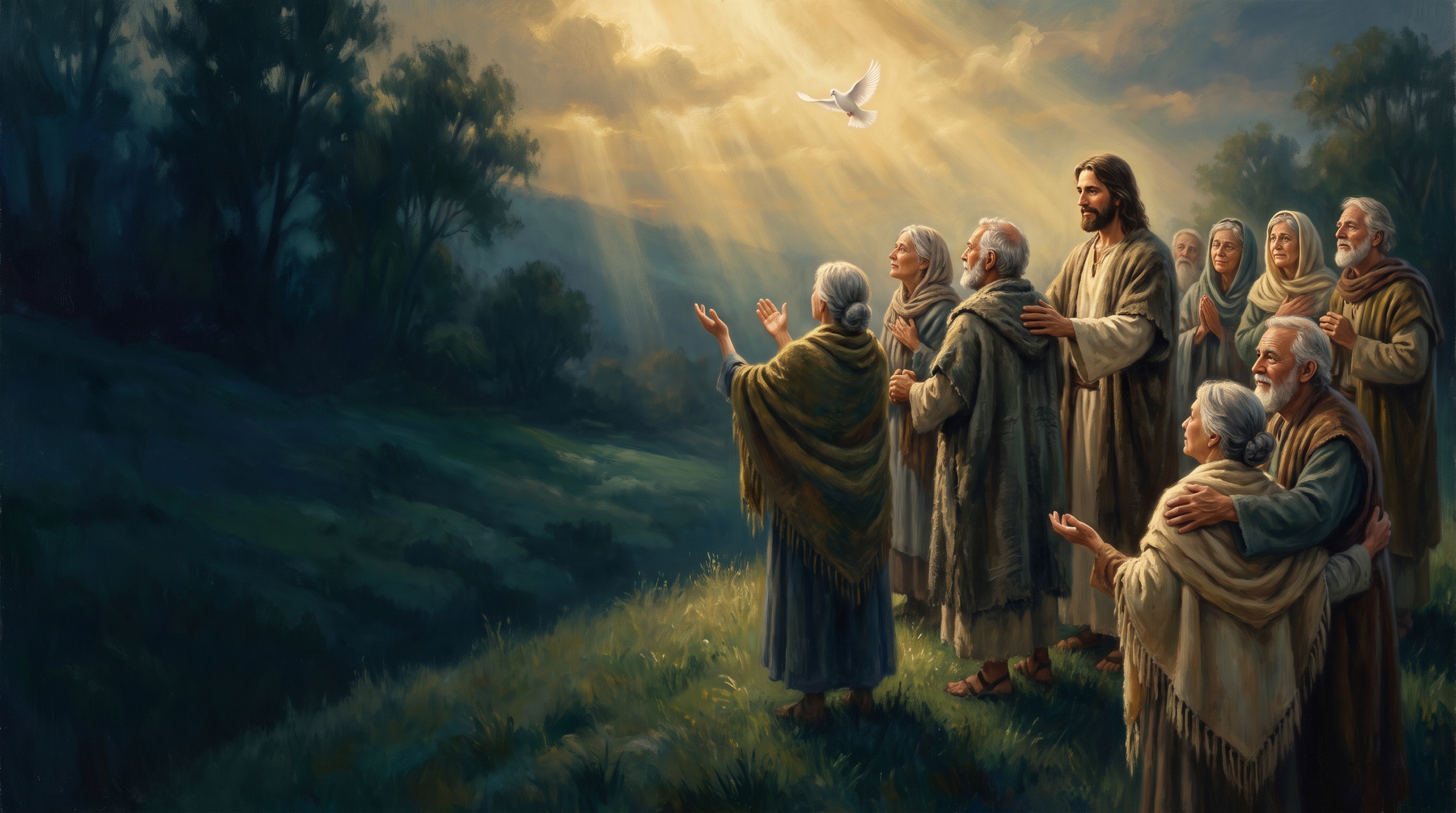
Jesus among older believers looking with gratitude toward radiant dawn light

Becomers · Five weekday devotionals

Look What
God Has Done

A week to stand in awe, recognize God's provision, give thanks, and see how every tenet leads us toward the love of Jesus.

“The Lord has done great things for us, and we are filled with joy.”
Psalm 126:3
BEGIN THE WEEK ↓

Sunday was not about finishing a program. It was about stopping long enough to see the fingerprints of God. He has been forming us through His Word, giving us people who know our names, carrying us through prayer, feeding us at shared tables, and turning ordinary people into ministers of His love.

This week, we are not asking, How much did we accomplish? We are asking, What has God done, what has God provided, and how can we thank Him?

The simple path is complete: read the passage, notice one gift from God, pray, and carry one phrase. Open Going Deeper when you want more Scripture. Open Marvel at This when you want one biblical connection and a fresh way to practice wonder. Missing a day does not put you behind.

If you are new to Becomers, you did not arrive after the good part. You may be part of what God provides next. You belong in this story too.

The seven-tenet journey

Every part of the Becomers rhythm becomes a way to receive and share the love of God.

1Becoming2God's Word3Tables4Prayer5Hospitality6Ministry7Love
01

Monday

When the Dream Became Real

We Are Becoming
Read Psalm 126:1-6 · NLT ↗
“Yes, the Lord has done amazing things for us! What joy!”

Psalm 126 begins with people trying to describe a deliverance so great that it felt like a dream. They laughed. They sang. Even the surrounding nations had to admit that the Lord had done something remarkable for them.

Then the psalm does something honest. In the middle of the celebration, the people pray, “Restore our fortunes, Lord.” They can remember a great work of God and still need Him to work again. Awe does not require us to pretend every problem is over. Gratitude simply refuses to let today's unfinished places erase yesterday's faithfulness.

That is the heart of a Becomer. We are not finished, and we are not forgotten. God has already done more than we could manufacture, and He is still at work in what remains incomplete. Philippians 1:6 does not say that we will complete the good work if we try hard enough. It says that He who began it will carry it on to completion.

Look back without nostalgia and look forward without fear. The God who gave the first seed also knows how to bring the harvest.

Carry itThe Lord has done great things for us, and He is not finished.
Pray itFather, open my eyes to what I have hurried past. The work of Yours I want to thank You for today is ____________.
Practice itTell one person, “I can see God at work in ____________.” If no person comes to mind, say it aloud to God. Either one counts.
Going Deeperoptional

Watch how remembering God's past faithfulness creates courage for an unfinished future.

  • Philippians 1:3-6 — Paul thanks God for people before he speaks about the work God will complete in them.
  • Joshua 4:1-9 — God tells Israel to build a visible reminder so future generations will ask what He did.
  • Psalm 77:7-15 — A troubled mind changes direction when it deliberately remembers the deeds of the Lord.

Ask the text: What changes in each passage after someone remembers what God has already done?

Whole picture: Psalm 126

Marvel at Thisoptional

Psalm 126 is one of fifteen Songs of Ascents in Psalms 120–134. These songs were associated with worshipers going up to Jerusalem. The people did not sing only after they arrived; they carried songs for the road.

Try this: Turn one memory into a traveling song. Finish this sentence and repeat it during an ordinary routine today: “God, You provided ____________, and I remember.”

02

Tuesday

The Giver Behind the Gift

Formed by God's Word
An older couple thanking God over bread and an open Bible

Read Deuteronomy 8:2-18 · NLT ↗
“Remember the Lord your God. He is the one who gives you power to be successful.”

Moses speaks to people standing at the edge of abundance. The wilderness is behind them. Homes, fields, bread, and full stomachs are ahead. His warning is surprising: scarcity is not the only time we are tempted to forget God. Plenty can make us forget where provision came from.

So Moses gives them a word they will need in the land: remember. Remember the manna. Remember the road. Remember the clothes that did not wear out and the feet that did not swell. Remember that ability, opportunity, strength, wisdom, and daily bread are gifts before they become achievements.

God's Word forms us by teaching us how to see. Without it, we can look at a provision and see only our own planning. Scripture gently turns our face back toward the Giver. It does not make effort meaningless; it places effort inside grace. The hands worked, but God gave the hands. The mind planned, but God gave the mind. The door opened, but God was already on the other side.

Gratitude is not denying what was hard. It is telling the whole truth about Who sustained us through it.

Carry itEvery good gift has a Giver.
Pray itGod, keep me from enjoying Your gifts while forgetting Your presence. Today I recognize Your provision in ____________.
Practice itBefore asking God for what is missing, name three provisions already present. Small things count: breath, Scripture, food, a person, strength for one more step.
Going Deeperoptional

Follow the biblical movement from need, to provision, to remembrance.

  • Exodus 16:11-18 — God gives enough for each day, and nobody is left with too little.
  • Matthew 6:25-34 — Jesus points to birds and flowers so ordinary creation can retrain anxious vision.
  • James 1:16-18 — Every good and perfect gift comes down from the Father, whose character does not shift like a shadow.

Ask the text: What does God provide in each passage, and what does He want His people to learn about Him through the provision?

Whole picture: Deuteronomy 8

Marvel at Thisoptional

When the Israelites first saw the bread from heaven, they asked, “What is it?” That question became the name manna in the biblical story. God's provision arrived before they even had a familiar category for it.

Try this: Notice one provision that does not look the way you expected. A changed plan, an unexpected helper, or even a closed door may deserve a second look before you decide God has not answered.

03

Wednesday

God Often Provides a Person

Shepherded at Tables · Prayer by Name · Food and Hospitality
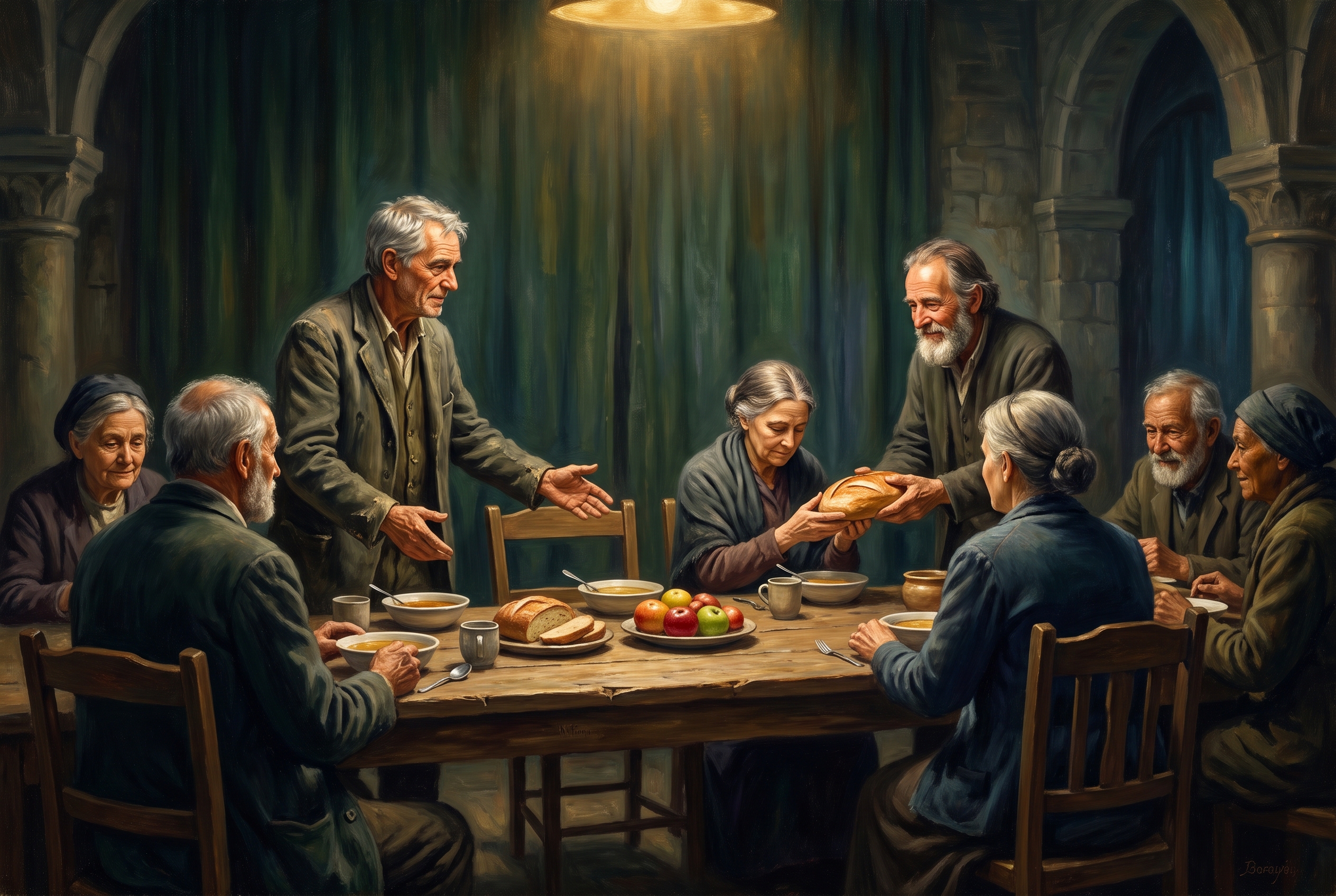
Older believers welcoming one another and sharing bread around a table

Read Acts 2:42-47 · NLT ↗
“They shared their meals with great joy and generosity.”

The first believers devoted themselves to teaching, fellowship, shared meals, and prayer. Then Luke shows us what those devotions looked like in a real community. Needs were noticed. Resources were shared. Homes opened. Food moved across tables. Praise rose. People who had been strangers became family.

Sometimes we ask God for encouragement, and He provides a person who remembers our name. We ask for strength, and someone prays while our own words are tired. We ask not to feel alone, and there is a chair waiting at a table. We ask for daily bread, and provision arrives in a casserole dish, a grocery bag, a restaurant invitation, or a meal made with love.

This does not make people the source. It reveals how generously God uses His body. The Lord who could provide without involving anyone often gives one person the dignity of carrying His kindness toward another.

Think about how much of God's care has reached you through somebody's ordinary obedience. Then think about the holy possibility that you may be part of His answer for someone else.

Carry itGod's provision often has a name and a face.
Pray itFather, thank You for the people through whom Your care has reached me, especially ____________. Show me whose name to carry today.
Practice itThank one person for a specific way God has used them. If they are no longer reachable, thank God for them by name. Either one counts.
Going Deeperoptional

Notice how often God's care becomes visible through shared life.

  • Romans 12:9-13 — Sincere love honors, serves, prays, shares, and practices hospitality.
  • Galatians 6:1-2 — Carrying another person's burden fulfills the law of Christ.
  • 1 Thessalonians 2:7-12 — Paul describes ministry with the tenderness of family, sharing not only the gospel but his own life.

Ask the text: Which verbs make love visible in these passages? Which one have you received from someone else?

Whole picture: Acts 2:42-47

Marvel at Thisoptional

The word translated fellowship in Acts 2:42 is koinonia. It carries the sense of participation and sharing, not merely being in the same room. Biblical fellowship is a life people take part in together.

Try this: At your next table, move one step beyond “How are you?” Ask, “What is one thing I can thank God for with you?” Then listen for a name, a need, or a provision worth remembering.

04

Thursday

Grace Became Shareable

Every Becomer Is a Minister
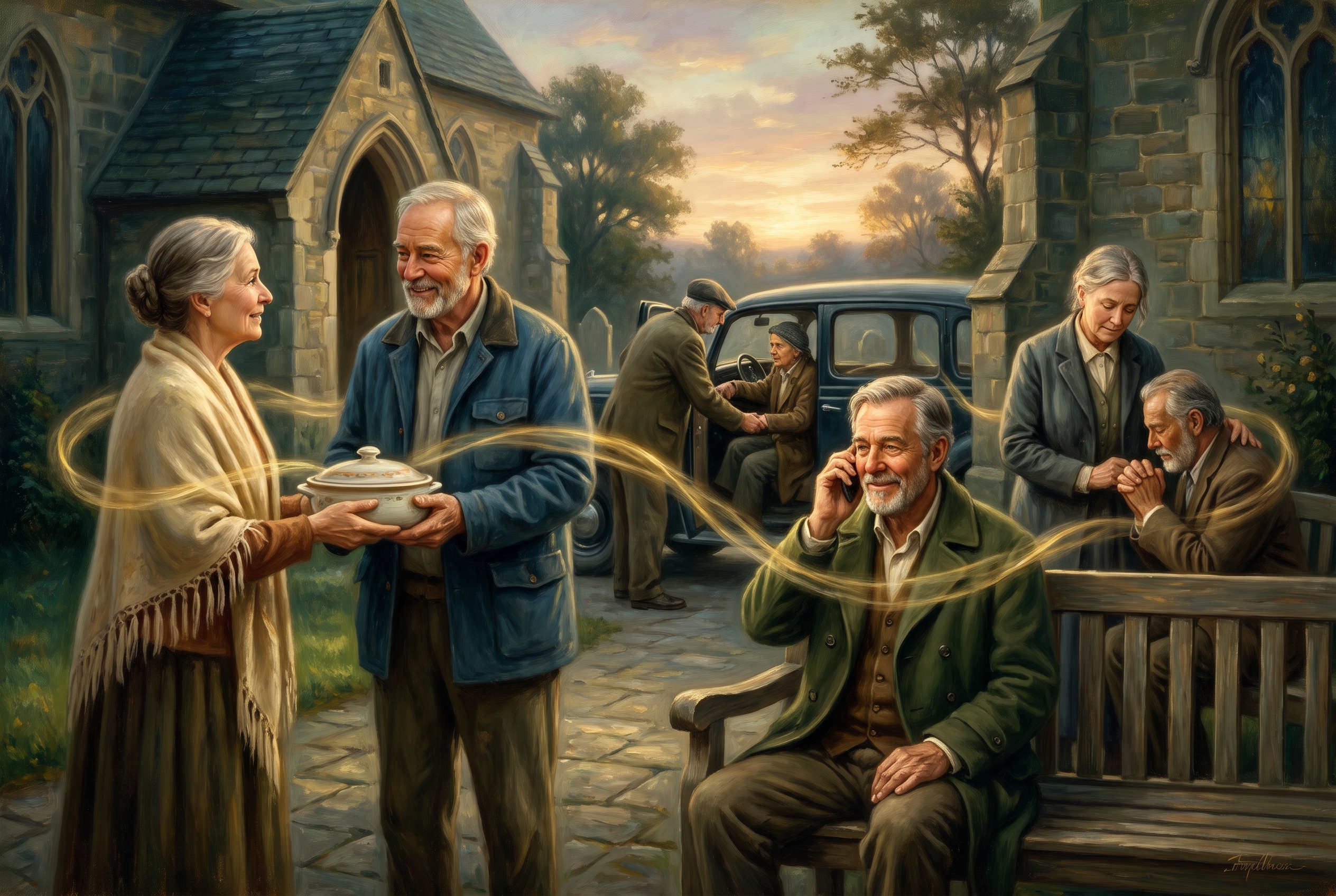
Ordinary acts of ministry connected by a ribbon of golden light

Read 1 Peter 4:7-11 · NLT ↗
“God has given each of you a gift from his great variety of spiritual gifts. Use them well to serve one another.”

God does not only provide things for His people. He provides His people for one another. Peter says each person has received a gift, and every gift is a piece of God's varied grace entrusted to a steward.

That means the question is not whether you are impressive enough to minister. The question is where grace has already taken shape in you. Perhaps you notice the person standing alone. Perhaps you remember details, cook generously, explain Scripture clearly, fix what is broken, make people laugh, recognize grief, pray with faith, give quietly, or know how to remain present when there is nothing to fix.

Your gift is not evidence that you are better than someone else. It is evidence that God intends to care for someone else through you. Even then, the glory returns to Him. Peter says that when we serve with the strength God supplies, God receives the glory through Jesus Christ.

This is ministry without pressure and gratitude without pride: God gave the grace, God supplies the strength, another person receives the blessing, and God gets the glory.

Carry itGrace came to me on its way to someone else.
Pray itHoly Spirit, thank You for making grace shareable through ordinary people. Supply what I need to bless ____________.
Practice itUse one gift in a small, complete way today. Give one call, prayer, welcome, meal, explanation, ride, or quiet kindness. Small and complete is still ministry.
Going Deeperoptional

These passages keep gift, service, dependence, and glory together.

  • 1 Corinthians 12:4-11 — Different gifts, the same Spirit, and a spiritual gift given to each person so everyone can be helped.
  • Ephesians 4:11-16 — Leaders equip God's people for works of service so the whole body grows toward Christ.
  • 2 Corinthians 4:7 — Treasure in fragile jars makes it clear that the surpassing power belongs to God, not us.

Ask the text: How do these passages keep a gifted person from either pride or the belief that they have nothing to offer?

Whole picture: 1 Peter 4:7-11

Marvel at Thisoptional

In the New Testament, the Greek word often translated gift (charisma) is closely related to the word for grace (charis). A spiritual gift is not a trophy for the gifted. It is grace given a practical way to travel.

Try this: Replace the question “Am I gifted?” with “Where does God's kindness seem to travel naturally through me?” The answer may be much more ordinary, and much more useful, than you expected.

05

Friday

The Miracle the World Can See

Known by Our Love
A diverse community showing the recognizable love of Jesus

Read John 13:31-35 · NLT ↗
“Your love for one another will prove to the world that you are my disciples.”

Jesus did not say the world would recognize His disciples by perfect meetings, impressive knowledge, identical opinions, or people who never disappointed one another. He pointed to a miracle ordinary people could see: the way His followers love one another.

And He gave that command on a difficult night. The cross was near. Betrayal was already moving. The disciples still misunderstood one another and Jesus. Yet He said, “As I have loved you, you should love each other.” Their love would not begin with their own supply. It would begin with His.

Every Becomers tenet leads here. God's Word forms us so that we can love truthfully. Tables make room for love to become personal. Prayer carries love by name. Food gives love a seat. Ministry gives love hands. Becoming means the Holy Spirit keeps making us more like Jesus, the One whose love is our source and pattern.

So we end this week in awe. Look at what God has provided: His Son, His Spirit, His Word, His people, daily bread, meaningful work, and grace that keeps becoming love. It is all God.

Carry itWe will be known by our love.
Pray itLord Jesus, let the love You have given me become visible to ____________. May every good thing point back to You.
Practice itChoose the smallest verifiable act of love you can complete today. Then do it without needing credit.
Jesus-SightingWatch for Jesus in a love that makes room, remembers a name, shares a provision, or stays when leaving would be easier.
Going Deeperoptional

Follow the source, shape, and witness of Christian love.

  • John 13:1-17 — Before Jesus commands the disciples to love, He kneels and shows them what His love does.
  • 1 John 4:7-12 — Love begins in God, appears in Christ, and becomes visible as His people love one another.
  • Colossians 3:12-17 — Love binds together compassion, kindness, humility, forgiveness, peace, Scripture, worship, and gratitude.

Ask the text: What does Jesus do before He tells the disciples what to do? How does receiving His love change the way we give it?

Whole picture: John 13

Marvel at Thisoptional

Jesus gives the “new command” after washing feet and after Judas leaves the room. He speaks about recognizable love when the community is already under strain. The command is not sentimental. It is cross-shaped.

Try this: Ask, “What would the love of Jesus make visible here?” Look for a concrete answer: a chair moved, a name remembered, a meal shared, an apology offered, a burden carried, or a person welcomed.

Our Week of Wonder

You do not need a long testimony. Complete one sentence:

“I saw God's provision in ____________, and I am grateful for ____________.”

Email Brian one sentence

[!important] Protect privacy

Use a first name or initials only. For anything sensitive, write Please call me instead of including details.

Final Declaration

It is all God.
We are becoming.
We will be known by our love.
Amen.

---